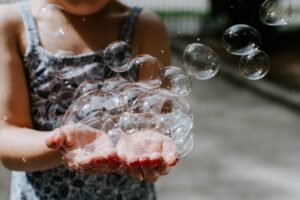
We all enjoy blasting bubbles and chasing after them because such fun activities remind us of our childhood memories. Intriguing, delicate, and beautiful, bubbles also symbolise the magic of flying. However, they’re more than about entertainment and aesthetics.
As we briefly dive into the magic of bubbles, let’s also discover the science behind them.
What’s the Relationship Between Bubbles and Science?
More than what people know, there is quite a bit of science involved in creating bubbles, such as the principles of elasticity, surface tension, chemistry, light, and geometry. Students explore these methods in a typical educational setting as they observe, experiment, research, and learn more about bubbles.Decoding Bubbles
A bubble is nothing more than air contained in a thin layer of soap film. Its surfaces are covered with soap molecules with a thin layer of water to help retain the air inside. They naturally take a rounded shape and are sealed if you reverse the direction of your wand. This results in contraction and reduces the tension in the bubble skin to the smallest amount of air inside. Once you close it, the bubble will shrink into a sphere form. As pretty as bubbles are, bubbles don’t last forever. When the water between the soap film surfaces evaporates, bubbles will naturally pop. However, because molecules move slower in a colder environment, bubbles can be retained for many minutes if you make them during the winter season. They also fly higher in cooler temperatures because there is less humidity and air pressure.#1: Do Bubbles Have Color?
These spherical air shapes are usually colourless, but they reflect light waves on the soap film’s outer and interior surfaces. As the water evaporates, the layers grow closer and change the hues. You may also find that bubbles mirror their surroundings on their glass-like surfaces.#2: How Do Bubbles Behave?
Due to surface tension, bubbles will come together at a 120-degree angle to form a shared wall. This is how they naturally become more efficient with their space. To create perfect hexagons, bubbles must be of equal size.#3: Can I Make My Own Bubble Formula?
Bubbles have become popularised and commercialised. You will see them packaged in bottles in almost every toy store and convenience store, but in reality, you can make your own version which you can share with your friends and family. Here, we’ll share a formula on how to make beautiful bubbles each time:- Use one-half cup of liquid dishwashing soap. Try to look for any dishwashing brand that is accessible and non-toxic for both children and adults.
- In a clean, covered container (or anything with a lid), pour six cups of distilled water and stir it into the dishwashing soap slowly. Blend well.
- Following the water, add 1/4 cup light corn syrup or one tablespoon of glycerin.
- Do not allow bubbles to develop while mixing the dish soap into the water.
- Glycerin or corn syrup should be added to the mix and stirred carefully.
- If bubbles appear, let the mixture rest overnight before using it.